
Love and Devotion in Celtic Culture
The Celtic peoples of ancient Britain, Ireland, Wales, and Brittany developed sophisticated cultural expressions of love and devotion that have profoundly influenced how we understand romance in contemporary Western traditions. Celtic love traditions emphasised commitment beyond mere sentiment; they honoured love as a binding force that transcended individual desire to encompass familial and spiritual dimensions. This holistic approach to love contrasts with more modern, individualistic conceptions and offers rich territory for those seeking to express romantic dedication through meaningful symbols and objects.
At the heart of Celtic love traditions lay the concept of unbroken bonds and eternal connection. Unlike cultures that represented love through ephemeral symbols, Celtic peoples created physical embodiments of romantic commitment designed to endure across lifetimes. Knotwork, in particular, became the visual language through which Celtic love was expressed; the continuous, interwoven patterns suggested that love itself followed no beginning and no end, but rather existed as an eternal force binding two souls together. This philosophical underpinning gave rise to jewellery traditions that remain deeply meaningful today.
The concept of handfasting emerged from Celtic romantic traditions as a form of trial marriage or symbolic union. Partners would literally bind their hands together, their union blessed by the community and witnessed by loved ones. This practice acknowledged love not as a private sentiment but as a social reality, a commitment recognised and honoured by the broader community. The physical act of binding, of creating an unbreakable knot, served as both ceremonial and symbolic affirmation of emotional union. Contemporary Celtic-inspired jewellery echoes this tradition, offering physical reminders of bonds that cannot be untied.
Examining Celtic love traditions provides insight into how ancient peoples understood and honoured some of humanity’s most profound emotional experiences. Rather than viewing love as exclusively romantic, Celts recognised love as encompassing partnership, family bonds, spiritual connection, and devotion to community. This expansive understanding created space for jewellery that celebrated not merely romantic attachment but the broader network of love that sustains human life and gives it meaning.
The Language of Celtic Knotwork
Celtic knotwork represents one of the most recognisable and enduring visual languages ever developed. These intricate, interwoven patterns appear throughout Celtic art, manuscripts, stonework, and jewellery, functioning as a form of visual communication that conveyed complex philosophical concepts through geometric design. For contemporary observers, Celtic knotwork symbolises eternity, continuity, interconnection, and the unbroken bonds between individuals. Each line flows seamlessly into the next, creating a pattern that appears to have neither beginning nor end; this visual characteristic became synonymous with eternal love.
Different Celtic knots carry specific symbolic meanings that amplify their significance when incorporated into love-focused jewellery. The Celtic lover’s knot, for instance, features two interlaced hearts enclosed within a continuous line, creating a visual representation of two individuals bound together yet retaining their individual identities. This design appeals to contemporary romantic sensibilities that emphasise partnership whilst honouring personal autonomy. Other Celtic knots evoke different aspects of love: the trinity knot suggests the unity of body, mind, and spirit; the spiral knot represents growth, evolution, and the cyclical nature of life and love.
Read More: Compression Gear Improves Performance And Boosts Training Recovery
When incorporated into Welsh gold jewellery, Celtic knotwork gains additional dimension. The warm rose tone of Welsh gold complements the delicate linework of knotwork designs, creating pieces that draw the eye through their visual intricacy. A necklace featuring Celtic knotwork functions simultaneously as a jewellery piece and as a visible symbol of the wearer’s values and understanding of love. Such pieces communicate to observers that the wearer appreciates depth, tradition, and meaningful symbolism; they signal that this jewellery represents something beyond mere decoration.
The educational aspect of wearing Celtic knotwork jewellery should not be underestimated. Each piece becomes a conversation starter, an opportunity to share knowledge about Celtic heritage and the profound symbolism embedded within ancient patterns. For collectors of Welsh heritage, wearing Celtic knotwork in Welsh gold creates a particularly poignant connection between personal identity and cultural pride. The jewellery becomes a vehicle for preserving and celebrating traditions that might otherwise fade from collective memory.
Welsh Courting Customs and Their Legacy
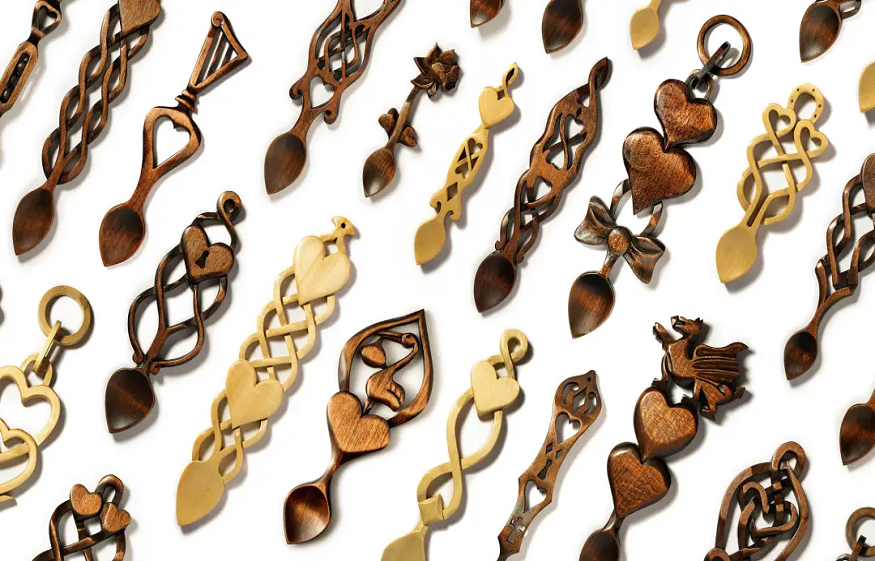
Welsh courting traditions developed within the context of Celtic culture but acquired distinctive characteristics reflecting Wales’s unique geographic, social, and spiritual circumstances. The tradition of the lovespoon emerged in Wales as a distinctive expression of romantic intention, with young men carving elaborate wooden spoons to present to young women they wished to court. The spoon functioned not as a functional kitchen tool but as a symbolic declaration; by investing time and skill into creating something beautiful specifically for a beloved, a suitor communicated his seriousness of intention and his willingness to invest effort into a relationship.
Lovespoon traditions carried specific symbolic elements understood within Welsh courting contexts. A spoon featuring intertwined patterns suggested bonding and unity; spoons decorated with hearts or romantic symbols communicated the suitor’s romantic intentions explicitly. The presentation of a lovespoon represented a crucial moment in courtship, a semi-formal proposal that elevated a relationship from casual affection to serious romantic consideration. Families understood the meaning of a received lovespoon; its presence in a household signalled that a courtship was underway and that marriage remained a likely future outcome.
Contemporary Welsh gold lovespoon jewellery captures the spirit of these ancient traditions whilst adapting them for modern romantic expression. Rather than wooden spoons, contemporary lovers can select from lovespoons crafted in precious Welsh gold, pieces that achieve the symbolic weight of traditional lovespoons with the permanence and value of jewellery. These pieces honour the tradition whilst acknowledging contemporary understandings of romantic gesture and commitment. A Welsh gold lovespoon pendant or charm functions as a portable declaration of romantic values, a way of saying that one understands and honours the traditions through which love has historically been expressed.
The legacy of Welsh courting customs influences contemporary Welsh approaches to romance and commitment. These traditions emphasise intentionality, visible commitment, and community recognition of romantic bonds. Contemporary Welsh couples often incorporate elements of these traditions into their own courtships and celebrations, selecting jewellery that echoes ancestral customs. This connection between past and present creates emotional richness; by wearing lovespoon jewellery or selecting Celtic-inspired pieces, contemporary wearers participate in a tradition stretching back centuries, positioning their own love story within a larger narrative of cultural continuity.
Read More: How a Professional Bag Manufacturing Company Ensures Quality, Durability & Bulk Supply
Celtic Hearts in Welsh Gold
The heart symbol, universally recognised as an emblem of love and emotion, finds particular expression in Celtic and Welsh traditions through designs that blend the romantic heart with Celtic artistic elements. Celtic heart jewellery typically features hearts embellished with knotwork, interlace patterns, or other distinctively Celtic visual language, creating pieces that communicate simultaneously on romantic and cultural levels. When crafted in Welsh gold, these pieces acquire additional significance; the warm rose tone of the metal enhances the emotional warmth conveyed by the heart symbol itself.
The Celtic Heart collection showcases how traditional Celtic motifs can be adapted to express contemporary romantic sensibilities. These pieces serve multiple functions: they communicate romantic love to partners, they signal cultural identity and heritage appreciation to observers, and they provide wearers with tangible reminders of what love means within Celtic philosophical frameworks. A Celtic heart necklace becomes not merely a piece of jewellery but a philosophical statement, a commitment to understanding love as something eternal, unbreakable, and culturally meaningful.
Celtic hearts prove particularly meaningful in engagement and commitment jewellery contexts. Rather than selecting a conventional solitaire diamond engagement ring, many couples seeking to honour their Celtic heritage opt for Celtic heart designs, either as primary engagement pieces or as complementary jewellery worn alongside traditional rings. These choices reflect a desire to make relationships explicitly visible through cultural symbols that carry generational significance. A Celtic heart engagement piece communicates to family and community that the couple understands their love within a broader cultural context, honouring traditions and values that matter deeply.
The emotional accessibility of the heart symbol ensures that Celtic heart jewellery appeals across age groups and contexts. A young person receiving their first romantic gift might select a Celtic heart pendant; a long-married couple might exchange Celtic heart bracelets as anniversary gifts; parents might pass Celtic heart pieces to children, creating heirlooms that carry both personal and cultural significance. The ubiquity and timelessness of the heart symbol, combined with the distinctive beauty of Celtic design, creates jewellery with unusually broad and enduring appeal.
Choosing Celtic-Inspired Pieces for Romantic Occasions
Selecting Celtic-inspired jewellery for romantic occasions requires considering both personal aesthetics and the symbolic weight you wish the piece to carry. Engagement rings offer a significant opportunity to express commitment through Celtic symbolism; rather than defaulting to conventional solitaire designs, many couples explore the range of engagement rings and promise rings incorporating Celtic elements. A ring featuring interlaced Celtic knotwork communicates commitment that transcends individual preference; it suggests a relationship built on shared values and cultural understanding.
Wedding rings similarly benefit from Celtic-inspired designs. Rather than selecting matching conventional bands, many couples choose wedding rings featuring Celtic elements, creating pieces that feel personally meaningful whilst honouring cultural heritage. Some couples opt for rings featuring the Claddagh tradition, with its symbolism of friendship, loyalty, and love; others select rings featuring simple knotwork that echoes ancient traditions. These choices transform wedding rings from functional markers of marital status into philosophical statements about what marriage means within one’s cultural context.
Jewellery gifts for romantic occasions might include necklaces, pendants, or bracelets featuring Celtic hearts, lovespoons, or other culturally meaningful symbols. Consider selecting pieces from the Affinity Heart collection, which specifically celebrates heart-centred themes, or exploring romantic-themed jewellery that communicates devotion through beautiful, meaningful design.
The ritual of presenting Celtic-inspired romantic jewellery mirrors the traditions of ancient Celtic courting. By selecting a piece that reflects cultural values and personal connection, you participate in a tradition stretching back centuries. The gift becomes not merely an accessory but a symbol of understanding; it says that you know your beloved’s values, that you share an appreciation for cultural heritage and meaningful symbolism, and that you are willing to invest thought and care into how you express your affection. This intentionality transforms the jewellery into something far more significant than its material composition alone.
Enduring Bonds: Celtic Symbolism for Modern Couples
In an era when romantic relationships face unprecedented social scrutiny and frequent dissolution, Celtic symbolism offers a counternarrative emphasising endurance, interconnection, and commitment that transcends individual circumstance. Modern couples drawn to Celtic traditions often seek stability and meaning in their relationships; they wish to position their partnerships within larger frameworks of cultural continuity and spiritual significance. By adopting Celtic symbolism through jewellery, contemporary couples essentially declare that they understand love as something more substantial than fleeting emotion or convenience.
The interlaced patterns of Celtic knotwork, suggesting endless continuity and unbroken bonds, resonate powerfully with modern couples seeking to communicate permanence. Unlike symbols that suggest completion or finality, Celtic knots suggest that relationships exist in a state of eternal becoming, continuously unfolding and evolving whilst remaining fundamentally unchanged in their essential nature. This philosophical framework appeals to contemporary couples who understand relationships as requiring active engagement, ongoing commitment, and willingness to grow together. The knotwork becomes a visual representation of this dynamic understanding.
Couples who select rings or other jewellery featuring Celtic symbolism make a statement about their relationship’s cultural and spiritual grounding. These choices acknowledge that love exists within cultural contexts that give it meaning and that honoring ancestral traditions strengthens contemporary relationships. For couples with Celtic heritage, these selections represent a return to roots and a commitment to preserving traditions across generations. For couples without Celtic ancestry, the adoption of Celtic symbolism represents an appreciation for cultural wisdom and a desire to align their relationships with values these traditions embody.
The longevity of Celtic symbolism across centuries demonstrates its power to communicate truths about human connection that transcend historical periods and cultural contexts. Modern couples wearing Welsh gold jewellery featuring Celtic knots, hearts, or other ancient symbols participate in a conversation stretching across millennia, adding their own voices to a chorus of lovers who have sought ways to express and preserve their commitments. This connection to the past infuses contemporary relationships with additional meaning and significance, suggesting that love itself partakes of something eternal and universal. Such jewellery becomes a bridge between individual relationships and the larger human story of love, commitment, and devotion.