

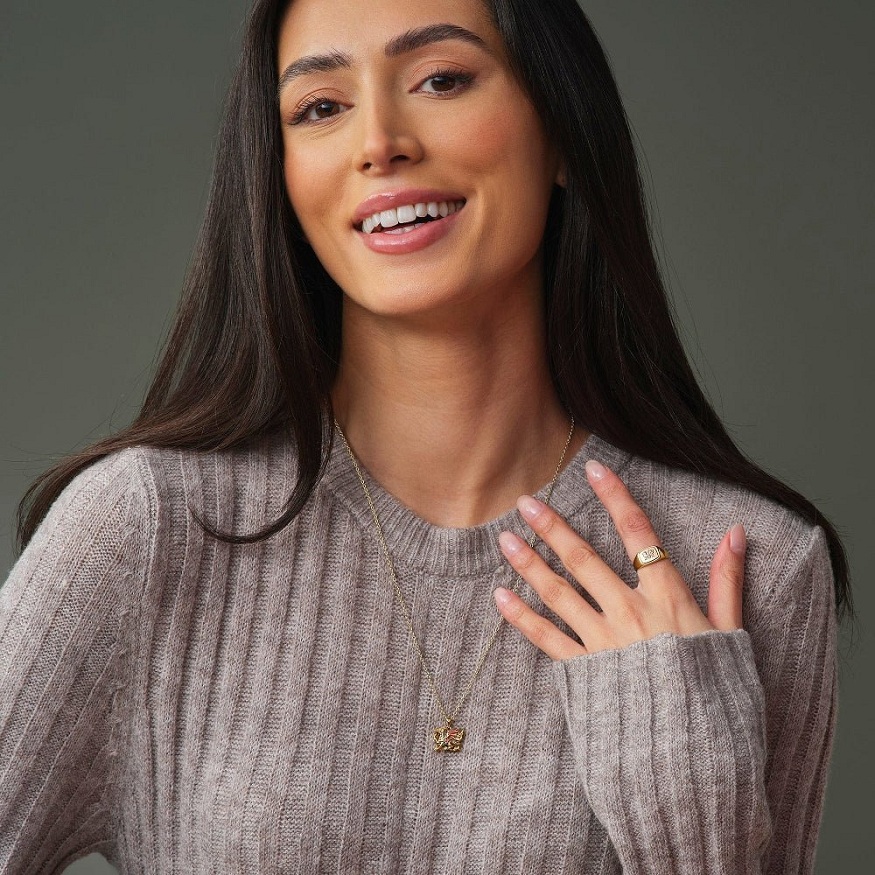
Look at the jewellery people actually own and a pattern emerges. Rings tend to be bought for oneself or given at moments of enormous consequence, and earrings are usually a personal purchase. The pendant is the piece that changes hands, which is why Clogau Outlet sees so much of its necklace stock leave in a gift box. It is what a husband buys for a twentieth anniversary and what gets handed over at a hospital bedside when there is nothing useful to say.
The necklaces here are genuine Clogau pieces containing rare Welsh gold, discontinued or past-season rather than diminished in any way, and the reduction in price does not reach the part of the gift that matters. Nobody opening a box asks which collection a design belonged to.
This piece is about giving. Why a pendant carries meaning more readily than any other category, how birthstones and occasion designs work, why a necklace is the safest jewellery you can buy for somebody else, what makes a chain last, and why a design that is no longer in production can be the better gift for exactly that reason.
Why the Pendant Became the Piece People Give
A pendant sits at the collarbone, in the space the eye goes to during conversation, and it is visible to the wearer every time they pass a mirror. That position does something no bracelet or earring manages, keeping the giver present in the wearer’s day without demanding anything.
There is also the matter of scale. A pendant is small enough to be worn constantly and substantial enough to be looked at closely, which makes it a natural carrier for meaning. Designs across the Welsh gold necklaces available tend towards forms that hold a story easily: a leaf, a heart, a knot, a single stone. Those are not abstract shapes but shorthand, and shorthand is what a gift needs.
The Material Adds Its Own Meaning
Welsh gold brings something to this that ordinary gold does not. The Clogau St David’s mine at Bontddu, near Barmouth in Gwynedd, was Britain’s largest and richest gold mine between 1862 and 1911, producing nearly 2.5 tonnes of gold. It closed for the last time in 1998, and no commercial Welsh gold mining takes place today.
That finality is the point. Give a piece containing rare Welsh gold and you are giving something from a source that will not produce any more. The material has been used by some members of the British Royal Family for over 100 years, including the wedding rings of 1947 and 2011, and has long been reserved for jewellery marking occasions of real weight.
The Safest Jewellery to Buy for Somebody Else
Giving jewellery is nerve-racking mostly because of sizing. A ring bought for the wrong finger cannot be worn until it has been altered, and asking for a ring size ruins the surprise. A bangle has to clear the hand, a watch needs links removing.
A necklace has none of these problems. Chains come with a clasp that fastens wherever it needs to, most designs accommodate a wide range of builds without adjustment, and if the length is genuinely wrong, a replacement chain is a small and inexpensive fix that leaves the pendant untouched. This is the single practical reason a pendant is the safest jewellery gift, and it is why so many people default to one.
Style risk is lower too, since a pendant does not have to coordinate with a wardrobe the way a statement earring does. Browsing the outlet’s women’s jewellery with the recipient’s existing pieces in mind will tell you whether they favour silver or warmer tones, simple forms or detailed ones.
Birthstones and the Month That Belongs to Someone
A birthstone pendant solves the hardest problem in gift-giving, which is making a bought object feel chosen. The stone is not a design decision. It is a fact about the person, and that makes the gift specific in a way that no amount of expensive generality can match.
It also gives you a way in when you do not know somebody’s taste well. You may not know whether your sister-in-law prefers a heart or a leaf, but you know she was born in March, and the birthstone jewellery collection narrows the whole field to a handful of pieces on that basis alone. The decision stops being aesthetic and becomes personal.
Beyond Birthdays: Stones That Stand for People
The convention extends further than the recipient’s own month. Parents wear the stones of their children. A pendant carrying two stones can stand for a couple, or for the month somebody came home. Grandmothers who already own everything become the easiest people to buy for once you start counting grandchildren.
Colour matters practically as well as symbolically. Some months land on stones that suit almost everybody, others on colours a particular person would never choose to wear. If the stone is wrong for them, use the month as a starting point and find a design that references it more quietly.
Pendants for the Occasions That Need Marking
Certain moments produce a specific kind of shopping. A christening, a wedding day, a fortieth, a retirement, a first Christmas after a bereavement. In each case the buyer is trying to find an object that will still mean something in twenty years, and jewellery is one of the few categories that can carry that load.
The advantage of a pendant here is that it becomes attached to the moment permanently and privately. Nobody else knows why a particular woman wears a particular pendant every year on a particular day, and that privacy is a large part of the value.
For occasions calling for more presence, the pieces in the diamond jewellery range give a pendant the extra light a milestone tends to want. Diamonds do one specific job in a gift, which is to signal that the occasion warranted them, and that signal is understood without anybody explaining it.
A Short Word on Length
Length deserves a mention, though it is the least troublesome variable in the whole exercise. Most pendants are supplied on a chain that suits the design, and the great majority of people wear a pendant somewhere between the base of the throat and the top of the breastbone. Buying towards the middle of that range is a safe default for a gift.
If you can see a necklace the recipient wears often, lay it flat and measure it. If you cannot, buy the pendant you like and accept that a different chain is a cheap and entirely normal adjustment later.
What Makes a Chain Last
The chain is the part of a necklace that fails, and it is the part buyers examine least. A pendant is a solid object and will survive being dropped. A chain is a long series of small joints, each one a potential point of failure, and it spends its life being pulled at by the weight it carries.
Look first at whether the links are soldered closed. Unsoldered links pull open under load, and a pendant of any real weight will find that weakness eventually. Then consider the style. Curb, belcher and box chains are built for carrying weight; fine snake and herringbone chains are beautiful and unforgiving, since a single kink is usually permanent.
Match the Chain to the Pendant, Not to the Price
The commonest mistake in necklace buying is a substantial pendant hung on a chain chosen for delicacy. The chain will stretch, the links nearest the bail will wear thin, and at some point it will part. If a pendant has real mass, it needs a chain with links thick enough to carry it, even if a finer one looks better in the photograph.
Check the bail as well, the loop the chain passes through. It should be smooth inside and generously sized, because a tight or roughly finished bail saws at the chain every time the pendant moves.
Why a Discontinued Design Can Be the Better Gift
There is an argument here that runs against instinct. A current-season pendant is, by definition, the one thousands of other people are buying this year. A discontinued design cannot be, because production has ended.
That makes a past-season piece a genuinely scarcer object, and scarcity is something a gift can use. The recipient is unlikely ever to see the same pendant across a dinner table, and if they do, it will be on somebody who also went looking. Because Clogau Outlet stock is discontinued, past-season and end-of-line jewellery at 30 to 50 per cent off RRP, the piece is better value at exactly the moment it becomes harder to find.
The saving does real work in a gift budget, often meaning a pendant with a stone rather than without one. Working through the reduced necklaces and pendants with a slightly higher ceiling than planned tends to produce a better gift than shopping a current range at the top of your budget.
Presentation and the Moment It Is Handed Over
The gift is not only the object. It is the box, the timing and the two or three sentences said whilst it is being opened, and those cost nothing.
Keep the presentation intact. The pause between a lid coming off and the piece appearing is part of the experience, so resist adding anything else to the box. A pendant sitting alone reads as considered; a pendant beside two other small gifts reads as one item on a list.
Say why you chose it. Not as a speech, but the one sentence connecting the design to the person. That the stone is their month, that the shape reminded you of something, that the gold came from a Welsh mine that closed before your daughter was born. That sentence is what turns the piece into the thing they will still be explaining to somebody in fifteen years. If you want to see how a pendant sits against the rest of what Clogau Outlet stocks before deciding, the complete outlet jewellery range shows the categories side by side.
Conclusion: Something That Keeps Being Given
The peculiar thing about a well-chosen pendant is that it does not finish being a gift on the day it is opened. It carries on, quietly, every time it is fastened. That is not true of most things people buy for each other, and it is why jewellery has held its place in the giving of gifts for as long as it has.
Clogau Outlet makes that easier to reach. The Welsh gold in a discontinued pendant came from the same finite source as the Welsh gold in a current one, the stamps are the same, the finishing is the same, and only the year the design left the catalogue has changed. The recipient gets a piece from a material that cannot be replaced, in a design that will not be made again.
Choose for the person rather than the occasion, check the chain properly, and give it with the sentence that explains it. Do that and you have bought something that will outlast every other gift given that day, most likely by several decades.